Electric vehicles are becoming “mobile power banks.” People have been saying this for years, but this year is different.
In June 2026, the National Development and Reform Commission (NDRC) and the National Energy Administration (NEA) jointly issued the 15th Five-Year Plan for Building a New Energy System. As a key part of building a new-type power system, vehicle-to-grid interaction (V2G) was incorporated into the plan, with a clear target: by 2030, aggregated controllable charging capacity for vehicle-grid interaction is to reach around 50 GW.
Image source: 15th Five-Year Plan for Building a New Energy System
What does 50 GW mean? It is roughly equivalent to the regulating capacity of fifty 1-GW large thermal power units. V2G has moved beyond the stages of “encouraged exploration” and “pilot validation” and is now entering a national-scale deployment phase backed by KPIs and a clear roadmap.
I. What Is V2G, and Why Has the Tipping Point Arrived Now?
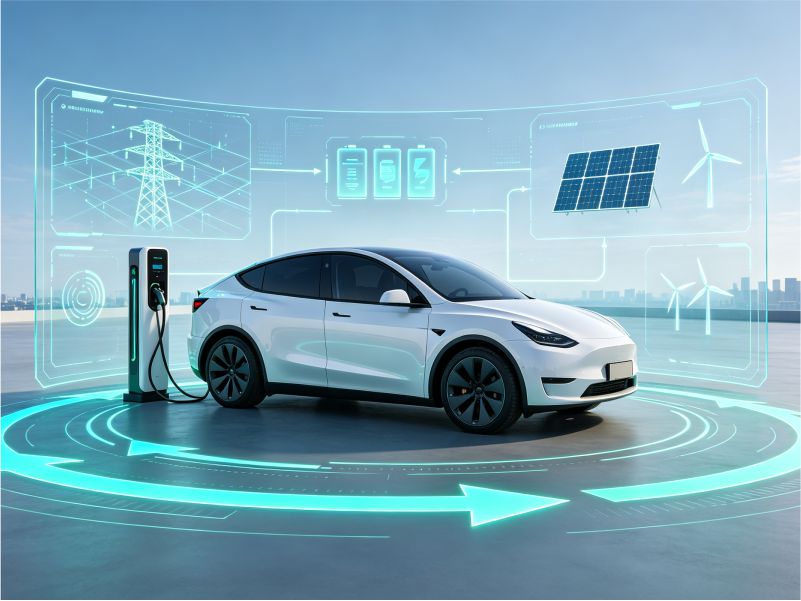
V2G stands for Vehicle-to-Grid, meaning “power can flow from the vehicle back to the grid”. Conventional charging is one-way: electricity flows from the grid to the vehicle. V2G makes the process bidirectional: EVs can not only charge, but can also discharge stored battery power back to the grid when needed.
The concept of V2G can be traced back to 1995, when it was first proposed by Amory Lovins, chief scientist at the Rocky Mountain Institute. That was 30 years ago.
Why has a concept proposed 30 years ago reached the threshold of large-scale deployment in 2026?
Reason 1: Policy now comes with a “KPI.” The 15th Five-Year Plan places V2G in a national-level energy plan and sets a quantitative target of 50 GW.
Reason 2: Costs have come down. On July 17, China Southern Power Grid (CSG) and Dongfeng Motor jointly unveiled the world’s first mass-produced vehicle with AC V2G capability, together with a matching charger. Previously, residential DC V2G chargers typically cost RMB 5,000–6,000 and required extensive supporting upgrades, making mass deployment in residential parking spaces difficult. AC V2G chargers now cost just over RMB 1,000 each—about one-sixth the cost of conventional DC V2G chargers. For vehicles equipped with bidirectional onboard chargers, bidirectional charging and discharging can be enabled through a remote over-the-air (OTA) update without any hardware replacement.
Reason 3: Technical standards are converging faster. The China Electricity Council (CEC) has begun drafting a national standard, Guidelines for AC V2G Charge/Discharge Control and Interactive Communication for Electric Vehicles. The long-standing issues of inconsistent communication protocols and high integration barriers among vehicles, chargers, and the grid are beginning to be addressed.
Reason 4: The new-type power system needs it. As the share of renewable energy rises, the grid needs more flexible regulation resources. EV batteries are already a readily available form of distributed energy storage. The grid now “needs” V2G: policy has set the target, falling costs have lowered the barrier, and grid demand has emerged. The tipping point follows naturally.
II. Deployment: From Planning to Reality
As policy takes shape, implementation is already moving forward across China. V2G is shifting from planning documents into real-world applications.
Feidong County, Anhui, installed the first privately owned residential V2G charger in a rural area on July 8. Based on a charge-off-peak, discharge-at-peak model, the owner can earn more than RMB 16,000 per year from discharging. V2G has now expanded beyond cities into county-level and rural areas.
Wuhan officially began piloting V2G electricity sales from private parking spaces on July 1, 2026, becoming the first city in central China to extend participation from public charging stations to private chargers. Vehicle owners pay about RMB 0.43/kWh to charge during overnight off-peak hours and can sell power back to the grid for close to RMB 1/kWh during the evening peak, earning a net margin of roughly RMB 0.5/kWh.
Hefei has built 16 V2G demonstration projects with 176 bidirectional chargers, providing a total reverse-discharge capacity of 56.4 MW. During the sixth dedicated vehicle-grid interaction event held on June 29–30, 642 vehicle participations were recorded, with total discharged energy exceeding 11.3 MWh. Vehicle owners participating in reverse discharging were eligible for special incentives of up to RMB 2/kWh.
Guangzhou is among China’s first V2G pilot cities. As of June 2026, the city had more than 1,000 V2G chargers, with cumulative discharge exceeding 1.8 GWh since the pilot began. In May, Guangzhou became the first city in China to designate the 28th of each month as a regular vehicle-grid interaction demonstration day. On the first such day alone, NEVs discharged 15 MWh back to the grid.
Four cities, four settings—rural counties, a major central-China city, industrial parks, and a first-tier metropolis. The V2G deployment map is expanding rapidly.
III. V2G Is Scaling Up, but Supporting Infrastructure Still Lags
Large-scale V2G deployment is only just beginning. The basic logic is straightforward: EVs charge when electricity prices are low and discharge when prices are high, capturing the peak-to-valley price spread. The principle is simple, and the technology has long been mature. What now needs to catch up goes beyond the technology itself.
Cost: The cost of AC V2G chargers has fallen to the RMB 1,000 range, but supporting expenses—such as distribution-side upgrades and local grid adaptation—have not yet been fully resolved. By contrast, DC V2G chargers cost 40%–60% more than conventional DC chargers. Deploying them at million-unit scale would require investment of several hundred billion yuan, while their larger footprint and higher retrofit requirements make mass installation in residential parking spaces difficult.
Standards: Communication protocols among vehicles, chargers, and the grid remain inconsistent, creating high integration barriers. In April this year, the CEC began drafting a national standard to address vehicle-charger incompatibility at the source, but implementation will take time.
Data and commercial model: Vehicles, chargers, and platforms still operate largely as separate systems, preventing the grid from coordinating them with precision, while mechanisms for sharing benefits among stakeholders have yet to be established. Industry discussions have proposed approaches such as returning 90% of revenues to users and introducing battery warranty and insurance protections, but a mature commercial model is still some distance away.
User concerns: Battery life and warranty policies remain major barriers to participation. Unless these two concerns are addressed, lower equipment costs alone may not be enough to attract sufficient users.
Distribution grid: Whether V2G can truly scale ultimately depends on the distribution grid. Every V2G charger connection may require corresponding upgrades or compatibility work for local distribution transformers, intelligent terminals, and metering equipment. Large-scale V2G deployment will ultimately test both the hosting capacity and the intelligence of the distribution grid.
Conclusion
Thirty years after the V2G concept was introduced, China has incorporated it into its 15th Five-Year Plan, and large-scale deployment is only beginning. Policy targets are now clear, cost barriers are falling, and real-world deployments are expanding across the country. The next question is whether the supporting infrastructure and capabilities can keep pace—and that will determine how far V2G can go.
All data in this article is compiled from publicly available reports.